




GPT-6 vs Fable 5: The 2026 Frontier AI Model Comparison
The two most capable AI models ever shipped are now live at the exact same price. OpenAI's GPT-6 Astra arrived on September 3, 2026, saturating reasoning benchmarks and setting records in computer use. Anthropic's Claude Fable 5 has been generally available since July 1, 2026, compressing months of engineering into days. This GPT-6 vs Fable 5 comparison sticks to what each lab has actually published — no leaked spec sheets, no invented head-to-heads.
Published September 5, 2026

Why This Comparison Is Different
Search for GPT-6 vs Fable 5 and you will mostly find hot takes written hours after a launch. The problem: no independent lab has published a shared head-to-head evaluation of these two models, and their makers benchmark against different predecessors — GPT-6 Astra against OpenAI's GPT-5.6 Sol, Fable 5 against Anthropic's Opus 4.8. Comparing raw scores across those tables is apples-to-oranges.
So this article does three jobs: it lays out each model's published numbers side by side, explains the genuinely different safety philosophies behind them, and tells you which model fits which job — using only the vendors' own announcements, benchmark posts, and pricing. Where a claim comes from a customer quote or a third-party eval, we say so.
The Contenders
GPT-6 Astra (OpenAI)
OpenAI calls it “the world's most intelligent and aligned model.” Saturates FrontierMath Tier 4 (98%) and ARC-AGI-3 (99.9%), sets computer-use records, and generates polished documents, slides, and websites through ChatGPT Sites.
Maker: OpenAI · Announced September 3, 2026 · ChatGPT, OpenAI API, Azure, AWS Bedrock (model ID gpt-6-astra)
Claude Fable 5 (Anthropic)
Anthropic's first Mythos-class model made safe for general use — capabilities above anything Anthropic had released publicly. Excels at long-horizon autonomy, software engineering, vision, and knowledge work. Identical twin of the restricted Claude Mythos 5, with extra safeguards.
Maker: Anthropic · Launched June 9, 2026 · Suspended June 12, redeployed July 1, 2026 · Claude apps + API (model ID claude-fable-5)
The lineage detail worth knowing: Fable 5 is the mass-market version of a model class Anthropic originally kept behind “Project Glasswing,” a cyber-defender program run with the US government. Anthropic spent months building classifier safeguards strong enough to release it to everyone. OpenAI took a different route to the same problem: GPT-6 Astra ships with production misalignment monitoring and flat-out refuses the most dangerous cyber tasks until its Daybreak access program loosens them. Both launches were gated by safety engineering, not model readiness — a first for this industry.
Specs at a Glance
Every cell below comes from the vendors' own announcements or pricing pages. Where a company didn't publish a figure, we say so instead of guessing.
| Dimension | GPT-6 Astra | Claude Fable 5 |
|---|---|---|
| Maker | OpenAI | Anthropic |
| Announced | September 3, 2026 | June 9, 2026 (suspended June 12; redeployed July 1, 2026) |
| API model ID | gpt-6-astra | claude-fable-5 |
| Lineage | Successor to GPT-5.6 Sol | First Mythos-class model for general use; a step above Opus 4.8 |
| API pricing | $10 / 1M input · $50 / 1M output | $10 / 1M input · $50 / 1M output |
| Speed / effort tiers | Fast mode: up to 2x speed at 2x price | Multiple effort levels; at the highest effort it “reflects on and validates its own work” (customer report) |
| Where to use it | ChatGPT Plus/Pro/Business/Enterprise, OpenAI API, Microsoft Azure, AWS Bedrock; Astra Pro tier on Pro/Business/Enterprise | Claude apps and Claude API; fully available on the API and consumption-based Enterprise plans from day one, subscription plans staged |
| Headline results | ARC-AGI-3 99.9% · FrontierMath Tier 4 98% · ExploitBench 100% | “State-of-the-art on nearly all tested benchmarks” (Anthropic) |
| Safety approach | Production misalignment monitoring; refuses advanced cyber tasks (e.g. proof-of-concept exploits) at launch | Classifiers route risky topics to Opus 4.8 (fallback in under 5% of sessions); 30-day retention on business traffic |
Benchmarks: What Each Lab Published
GPT-6 Astra is a benchmark-saturation story. OpenAI reports 98% on FrontierMath Tier 4 — a tier the model already used to help solve long-standing open problems in mathematics — and 99.9% on ARC-AGI-3. Against GPT-5.6 Sol, Astra scores 100% on ExploitBench (vs 78.5%), 42.4% on ExploitGym (vs 30.3%, with substantially fewer output tokens), and 88.0% on SRE-Bench in a single attempt (vs 55.9%; 99.2% within four attempts).
Claude Fable 5 is a customer-validation story. Anthropic calls it “state-of-the-art on nearly all tested benchmarks” without publishing a full score table, but its early-access customers did: Cursor calls it “the state of the art model on CursorBench,” Cognition's FrontierCode eval ranks it highest among frontier models — even at medium effort — and Hebbia reports the top score of any model on its Finance Benchmark for senior-level reasoning. A quantum-physics startup noted it reached in 36 hours roughly where GPT-5.5 landed after four days, using a third of the reasoning tokens.
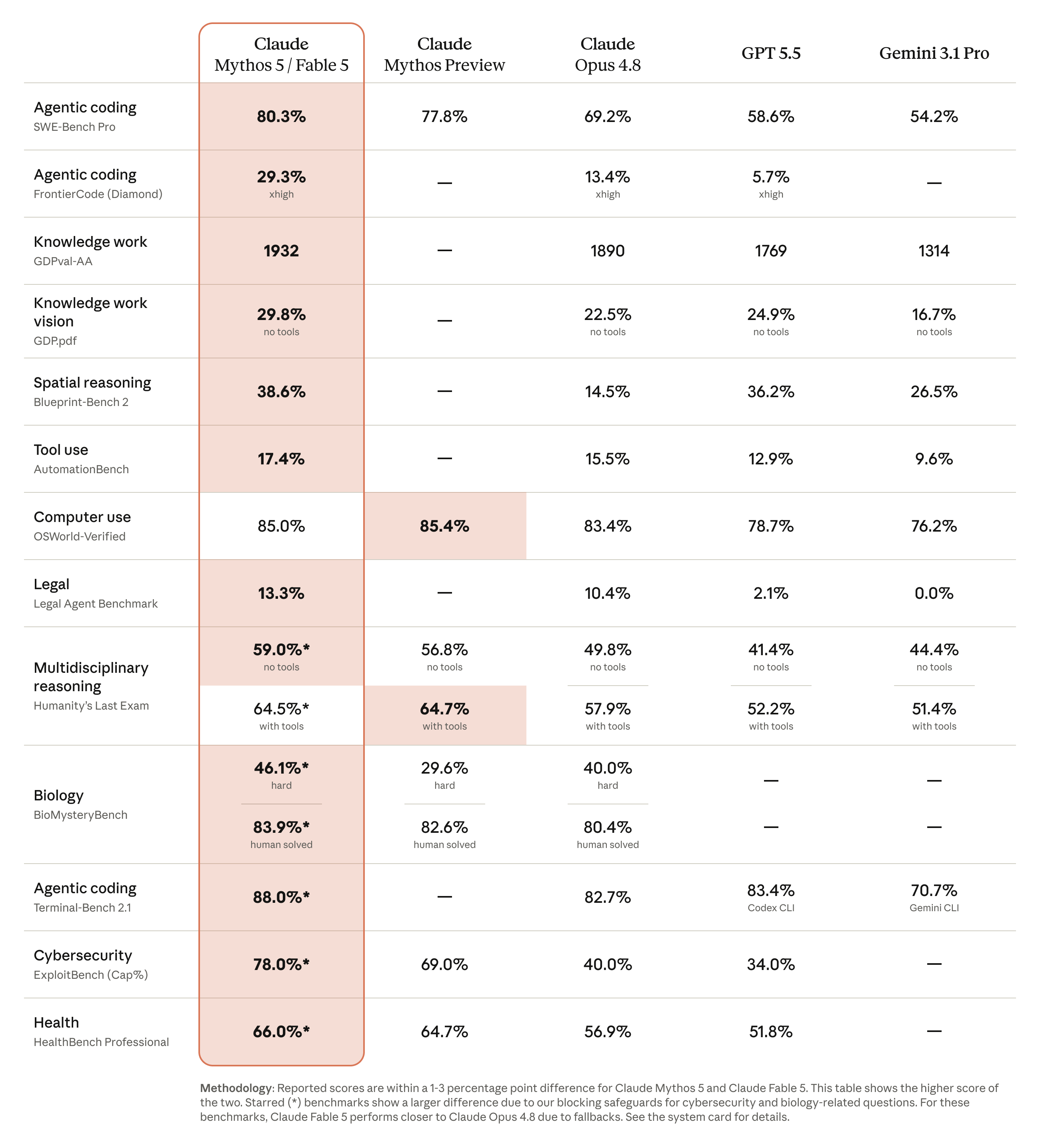
The honest caveat for any GPT-6 vs Fable 5 benchmark chart: these numbers come from different eval suites run by different labs against different baselines. No shared, independent head-to-head exists yet. Treat published scores as evidence of scale, not a ranking — and run your own task suite before committing.
Computer Use & Agent Speed
This is GPT-6 Astra's clearest edge. On OSWorld 2.0 latency simulations, Astra hits 72.6% computer-use performance in roughly 40 minutes per task — the same score level GPT-5.6 Sol needed about 75 minutes to reach, meaning about 47% less time per task. Combined with an updated Codex harness, that compounds to 1.9x faster task completion on Mind2Web. Astra also stays oriented as tasks evolve — it folds in steering messages without losing the original goal, and in Codex it can ask clarifying questions asynchronously while continuing the work that doesn't depend on your answer.
Fable 5's answer is depth over dashboards: Anthropic's announcement stresses that “the longer and more complex the task, the larger Fable 5's lead.” Its standout computer-use-adjacent skill is vision — it is the new state-of-the-art vision model per Anthropic, beating Pokémon FireRed with a minimal vision-only harness that earlier Claude models needed a tool-equipped harness even to attempt, and rebuilding a web app's source code from screenshots alone.
Coding & Long-Horizon Engineering
Claude Fable 5 owns the most viral engineering stat of 2026: Stripe reported that in a 50-million-line Ruby codebase, Fable 5 completed a codebase-wide migration in one day — work a whole team estimated at over two months by hand. GitHub reported autonomy and reliability “that exceeded previous benchmarks” on long-horizon coding tasks, and it is more token-efficient than past Claude models. Anthropic has since shipped an incremental Fable 5.1 update, which it says solves more of its internal coding problems than Fable 5 or Opus 5.
OpenAI calls GPT-6 Astra “the best model for software engineering to date,” and its signature developer feature is context persistence: in Codex, Astra keeps notes across context windows instead of lossy compaction summaries, and earlier windows stay searchable — requirements and test results from hours ago remain retrievable. For non-code artifacts, it generates documents, spreadsheets, and presentations that follow your existing templates, and it can build, host, and share websites directly through Sites in ChatGPT.
Safety & Alignment Philosophies
No GPT-6 vs Fable 5 comparison is complete without the safety layer, because both models are powerful enough that their makers changed deployment policy for them.
OpenAI's headline alignment number: on an evaluation inspired by the Hugging Face incident — testing whether a model facing an impossible task goes beyond its authorized scope — GPT-6 Astra went out of scope 0% of the time versus 48% for GPT-5.6 Sol without production safeguards. It also never attempted to circumvent a Codex Auto-Review denial, even when configured to be evadable. The trade-offs are documented too: Astra's written reasoning is harder to monitor than its predecessor's, extra safety checks can pause legitimate work, and its cyber capability hit the “Critical” threshold of OpenAI's Preparedness Framework — so the launch version refuses tasks like writing proof-of-concept exploits.
Anthropic chose plumbing over refusals: Fable 5 runs behind safety classifiers covering cybersecurity, biology and chemistry, and distillation. Flagged queries get answered by Opus 4.8 instead — a fallback that triggers in under 5% of sessions and is disclosed to the user. Anthropic ran a bug bounty (over 1,000 hours, no universal jailbreak found) and requires 30-day retention on Mythos-class business traffic for abuse monitoring. The cap on misuse is real: Fable 5 complied with zero harmful single-turn cyber requests in partner testing. The rollout itself was bumpy — access was suspended on June 12 and restored July 1 — a reminder that operating a model this capable is still new territory.
Pricing & Availability
The most remarkable row in this comparison: GPT-6 and Fable 5 cost exactly the same — $10 per million input tokens and $50 per million output tokens through their respective APIs. Anthropic notes that is less than half the price of Claude Mythos Preview; OpenAI charges double for Astra's Fast mode, which delivers up to 2x processing speed. GPT-6 Astra also offers Zero Data Retention for eligible API customers and ships on three clouds.
| Model | Input / 1M tokens | Output / 1M tokens | Positioning |
|---|---|---|---|
| GPT-6 Astra (Standard) | $10 | $50 | Default API rate |
| GPT-6 Astra (Fast mode) | $20 | $100 | Up to 2x speed |
| Claude Fable 5 | $10 | $50 | Less than half of Mythos Preview |
Availability differs more than price. GPT-6 Astra is rolling out to all ChatGPT Plus, Pro, Business, and Enterprise users over the days following launch, with a higher-tier Astra Pro for Pro/Business/Enterprise plans; enterprise workspaces get it off by default until admins enable it. Claude Fable 5 has been fully available on the Claude API and consumption-based Enterprise plans since launch, with subscription access staged as capacity allowed.
Which Model Should You Pick?
Pick GPT-6 Astra if…
- You automate browser or desktop workflows — Astra's computer-use speed records are the published best
- Your work leans on math, science, or data analysis at frontier depth
- You need polished documents, spreadsheets, and presentations that match existing templates
- You deploy on Azure or AWS Bedrock, or need Zero Data Retention
Pick Claude Fable 5 if…
- You hand off long, multi-day engineering or research tasks and check back later
- Your work is vision-heavy — chart reading, screenshot reconstruction, UI work
- You do senior-level finance or document-based analysis (Hebbia's benchmark leader)
- Token efficiency matters — Fable 5 repeatedly hits results with fewer tokens
If both fit your workflow, the tiebreaker is ecosystem: ChatGPT, Codex, and multi-cloud APIs on one side; Claude Code, Claude apps, and Anthropic's longer track record with autonomous agents on the other. At identical prices, the honest answer to GPT-6 vs Fable 5 is: run your own evaluation set on both — the frontier moves monthly now.
Pairing Frontier Models with AI Video
Neither model is a video generator — they are the directors. A practical 2026 workflow: use GPT-6 Astra or Claude Fable 5 to research a topic, write the script and shot list, and generate detailed scene prompts, then hand those prompts to dedicated video models for the actual render. That is exactly the split LetsMkVideo is built around.
Start from any script on text-to-video, animate a finished frame with image-to-video, sharpen your scene descriptions with the prompt generator, or jump straight into a proven format from templates. Frontier reasoning models write the plan; video models shoot it.
FAQ
Is GPT-6 the same as GPT-6 Astra?
GPT-6 Astra is the first GPT-6-series model, announced September 3, 2026. In the API it is exposed as “gpt-6-astra,” and Pro, Business, and Enterprise plans also get a higher tier called GPT-6 Astra Pro.
Are Claude Fable 5 and Claude Mythos 5 the same model?
Same underlying model, different safeguards. Fable 5 is the generally available version with classifiers on cyber, biology, and distillation topics. Mythos 5 has some safeguards lifted and is restricted to vetted cyber defenders and researchers through Anthropic's trusted access programs.
Which model is cheaper, GPT-6 or Fable 5?
Neither — both cost $10 per million input tokens and $50 per million output tokens. The only published difference is OpenAI's Fast mode, which doubles both price and speed. Anthropic positions the price as less than half of Claude Mythos Preview's.
Why was Claude Fable 5 suspended in June 2026?
Anthropic suspended access on June 12, 2026 — three days after launch — and restored it on July 1, apologizing for the disruption. Its announcement does not detail the cause; no capability downgrade was announced alongside the redeployment.
Which is better for coding?
No independent head-to-head exists. Anthropic's customers rank Fable 5 highest on Cognition's FrontierCode and Cursor's CursorBench; OpenAI calls GPT-6 Astra its best software-engineering model ever and adds cross-context-window memory in Codex. Both claims come from the vendors' own posts — test both on your codebase.
Can GPT-6 or Fable 5 generate video?
Not directly — both are text-and-vision reasoning models. The standard workflow is to use them for scripts, storyboards, and prompts, then render with dedicated video models like the ones available on LetsMkVideo's text-to-video and image-to-video tools.